
0 ItemsView Cart

Updated on April 03, 2026
Noise from plumbing pipes is a common issue in both residential and commercial buildings. It often presents as rushing water inside walls, vibration in ceilings, or sound that seems to carry well beyond the location of the pipe itself.
In most cases, the underlying issue is not airborne sound. It is vibration.
As water moves through plumbing lines, particularly PVC pipes, the pipe can vibrate and transfer that energy into surrounding framing. Once vibration enters studs, joists, or other structural elements, it can travel through the building and become audible in adjacent spaces.
Pipe wrap is used to address this condition at the source.
What Is Pipe Wrap
Pipe wrap is a flexible soundproofing material used to reduce noise from vibrating plumbing pipes. It is applied directly to the pipe surface, where it helps limit vibration and reduce how much sound is transferred into surrounding framing.
The function is straightforward. By adding mass and damping to the pipe, the material reduces how much the pipe can move in response to water flow and how much of that movement is transmitted into the structure.
Before going further, it is important to clarify a common point of confusion. Standard pipe insulation is designed for thermal performance. It may slightly soften incidental sound, but it does not provide the mass needed to control vibration. In most plumbing noise cases, vibration is the primary issue.
You may also hear pipe wrap referred to as pipe lag or pipe lagging. In residential plumbing applications, these terms are sometimes used interchangeably and generally describe a flexible barrier material wrapped directly around smaller plumbing lines.
Why Plumbing Pipes Get Noisy
Plumbing noise typically results from a combination of pipe material, installation conditions, and water movement.
Modern plumbing systems often rely on PVC piping. Compared to copper, PVC is lighter, which can make vibration more noticeable. However, material alone does not determine whether a system will be noisy.
Several factors contribute to the problem:
- Water turbulence inside the pipe
- Pressure changes that cause the pipe to shift
- Direct contact between the pipe and surrounding framing
- Vertical drain stacks carrying water between floors
Installation details, including pipe supports and spacing, also play an important role.
Once vibration transfers into framing, it can travel through walls and ceilings. This is why plumbing noise is often heard in adjacent rooms or in spaces that are not directly connected to the pipe.
How Pipe Wrap Works
Pipe wrap addresses plumbing noise by reducing vibration at the pipe itself.
When a dense material is applied directly to the pipe, it increases resistance to movement. At the same time, the material helps dissipate vibration energy before it transfers into the surrounding framing.
Two effects are at work:
- The added mass makes it more difficult for the pipe to vibrate
- The damping layer reduces how much vibration energy is passed into the structure
A bare pipe can carry vibration efficiently and transfer it into whatever it is touching. Wrapping the pipe interrupts that path and reduces the amount of energy that leaves the pipe.
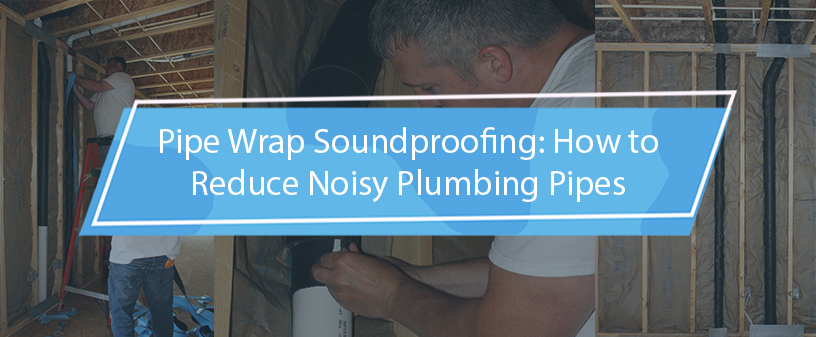
For plumbing applications, Quiet Wrap™ Pipe Soundproofing Wrap is designed for this type of use. It combines a mass-loaded vinyl barrier with an acoustic foam layer and is applied directly to the pipe.
Where Pipe Wrap Is Used
Pipe wrap is used in locations where plumbing noise is audible in occupied spaces.
In residential settings, this commonly includes bathroom walls, kitchen drain lines, laundry areas, and vertical plumbing stacks. In multi-story buildings, these stacks are a frequent source of noise between floors.
In commercial applications, pipe wrap is often used in multi-family housing, hotels, and mixed-use buildings where plumbing runs near living or working areas.
PVC pipes are most commonly treated because they tend to transmit vibration more readily, but the same approach applies to other pipe types.
Installation is typically done during construction or renovation, when pipes are accessible. In some cases, it can also be applied in retrofit conditions if access is available.
Installation Considerations
Performance depends heavily on how the material is installed.
One of the most common issues is incomplete coverage. Pipe wrap must fully surround the pipe to limit vibration effectively. Any exposed section can continue to transmit vibration.
The material should be applied with consistent tension, with each pass slightly overlapping the previous layer. This creates continuous coverage along the pipe.
A useful reference is the wrap on the handle of a tennis racket. Each layer overlaps to form a uniform surface. The same principle applies here.
Before installation, it is important to measure the full pipe run and account for overlap to ensure sufficient material is available.
When Pipe Wrap Is the Right Solution
Pipe wrap is appropriate when the primary issue is vibration from plumbing pipes inside walls, ceilings, or mechanical spaces.
This includes most residential plumbing noise issues, as well as many light commercial applications.
It is particularly effective when installed before walls or ceilings are closed, allowing full access to the pipe.
When a Different Solution Is Required
Pipe wrap is designed for plumbing pipes and smaller mechanical lines. It is not intended for larger systems or high-noise industrial conditions.
Applications such as large ducting, gas lines, or major mechanical piping typically require heavier barrier lagging systems.
In those cases, materials such as Quiet Lag™ are used. These products are designed for larger surfaces and higher noise levels where standard pipe wrap is not sufficient.
Selecting the correct material depends on the type of pipe, the source of the noise, and the overall installation.
Testimonial:
When we built our home, we reached out to Soundproof Cow for material recommendations. We decided to wrap the PVC pipes running from upstairs to downstairs with Quiet Wrap Pipe Soundproofing Wrap. Our neighbors’ home was built around the same time, and the difference is night and day. The plumbing from the bathroom runs right behind the couch, and the water noise is almost inaudible. We also decided to install the Quiet Batt Soundproofing Insulation in our shared and exterior walls. Soundproofing has been essential to our family’s quality of life. The demands of shift work and changing sleep schedules have made soundproofing a necessary addition to our home. My wife can go about her day, and the kids can play and enjoy themselves without interrupting my sleep. We have had multiple friends and family members comment on how quiet the downstairs is while someone is using the bathroom upstairs. We highly recommend the Quiet Batt Soundproofing Insulation and Quiet Wrap Pipe Soundproofing Wrap.
Thank you again, Soundproof Cow!
— Matthew D, Hagerstown, MD
Frequently Asked Questions
What causes plumbing pipes to make noise in walls?
Water movement and pressure changes can cause the pipe to vibrate. That vibration transfers into surrounding framing and travels through the structure.
Does pipe insulation stop pipe noise?
Insulation can help reduce echo inside a wall cavity, but it usually does not provide enough mass to stop vibration from the pipe itself.
How much pipe wrap do I need?
Pipe wrap should fully surround the pipe with slight overlap on each pass. Measuring the full pipe run in advance helps ensure proper coverage.
Can pipe wrap be installed after construction?
Yes, but access to the pipe is required. Installation is easiest during new construction or renovation before walls and ceilings are finished.
Still Hearing Noisy Pipes?
Plumbing noise is usually the result of vibration, installation conditions, or both.
If you are not sure what is causing the issue, our team can help you evaluate your situation and determine whether pipe wrap, a heavier lagging solution, or another approach is appropriate.
Give us a call for expert acoustic support at 866-405-7794 or submit a free acoustic analysis now.

About Ryan Ingram