0 ItemsView Cart


Updated on April 16, 2026
Most DIY soundproofing mistakes happen before installation even starts. People hear a noise problem, search for a product, and buy something before they understand what is actually causing it.
This usually happens because not all noise problems are the same. Some involve sound transfer through a wall, ceiling, or floor. Some involve leakage through gaps. Some come directly from the source. Others are caused by sound reflecting inside the room.
The right solution depends on the type of noise and the level of work involved. Some fixes are simple and targeted. Others depend on the full assembly working together.
Why DIY Soundproofing Projects Often Go Wrong
-
The product gets chosen before the problem is identified
Many people start with a material before they understand whether the issue is sound transfer, echo, or vibration at the source.
That leads to predictable mistakes. Acoustic products get used where sound blocking is needed. A shared wall gets treated when the sound is actually leaking around the door. A plumbing noise problem gets treated at the wall instead of at the pipe.
The result is the same: the wrong fix gets applied to the wrong condition.
-
Not every noise problem requires soundproofing
Some problems are caused by sound leaking through gaps. Others are caused by reflection inside a room. Others come directly from the source, like noisy plumbing pipes.
That distinction matters. If the issue is an air gap, sealing may be the first step. If the issue is reflection, absorption is the right category. If the source itself is making the noise, source treatment may be the most direct path to solving the issue.
Treating every noise issue like a soundproofing problem adds work without improving results.
-
Some fixes are simple, while others depend on a full system
A door sweep, acoustic panel, or pipe wrap is very different from rebuilding a wall or ceiling assembly.
A targeted fix addresses a specific weakness. A wall, ceiling, or floor project depends on layers, transitions, sealing, and how the system works as a whole. The more a project depends on the assembly, the more important execution becomes.
Start Here: What Kind of Noise Problem Are You Solving?
-
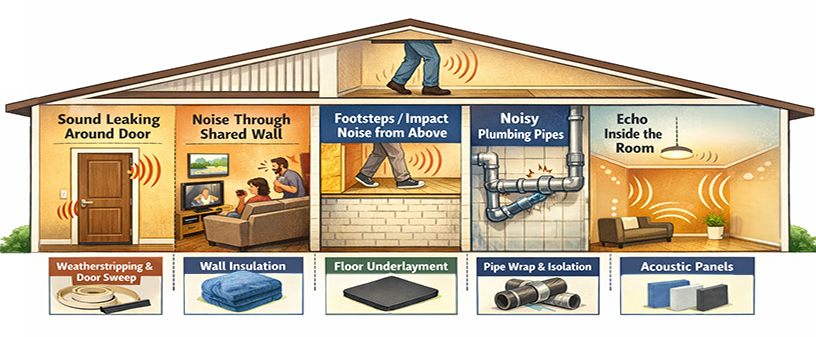
Sound leaking through walls, ceilings, or floors
This is a sound transfer problem.
Examples may include hearing voices or TV through a shared wall, hearing music from the next room, or hearing footsteps from above. In these situations, sound is moving through the structure. That means the problem is tied to the wall, ceiling, or floor assembly itself, not just to the surfaces you see.
When sound is moving through structural elements, the solution usually has to address the assembly.
-
Sound leaking around a door
This is often an air gap problem first.
Examples may include hearing hallway noise through a closed door or hearing conversations clearly through a bedroom or office door. In many spaces, the door is the weakest point. Small gaps at the sides, top, or bottom give sound an easy path through.
If sound is bypassing the wall through those openings, treating the wall first will not solve the main problem.
-
Noisy plumbing pipes
This is often a source-noise problem.
Examples may include drain pipe noise, flushing sounds in the wall, or rushing water sounds from accessible plumbing lines. In these cases, the pipe itself may be generating and radiating the sound.
That changes the starting point. If the pipe is accessible, source treatment may be more practical than opening the wall and rebuilding the surrounding assembly.
-
Echo and poor acoustics inside a room
This is an acoustic treatment problem, not a sound-blocking problem.
Examples may include a home office that sounds harsh or hollow, too much reverberation in a gym, restaurant, or studio, or speech that sounds unclear inside the room. The issue here is not sound entering from another space. The issue is reflected sound inside the room.
When the problem is echo or reverberation, the right fix improves the sound within the room rather than trying to block transmission between rooms.
The Best DIY Starting Points by Problem Type
If you want a broader overview before troubleshooting a specific issue, start with our How to Soundproof a Room Video, then use the sections below to identify the specific problem and where to start.
-
Noise Through Doors
For many DIYers, this is one of the easiest and most overlooked places to start.
If sound is leaking around the door, solutions may include Quiet Door™ Perimeter Seal and Quiet Door™ Sweep. These products help close common sound leaks around the door perimeter and threshold, which are often the first places to address when noise is slipping past a closed door.
Those are targeted fixes for a targeted weak point. If the problem is leakage at the door, addressing those gaps may be more effective than treating the wall first.
-
Pipe Noise
Quiet Wrap™ Pipe Soundproofing Wrap is a good DIY option when the noise is coming from accessible plumbing pipes and the sound is being radiated directly from the pipe surface. It is designed to wrap the pipe itself, helping reduce the noise at the source before it moves further into the wall or room.
It works best when used to treat noisy drain pipes, wastewater lines, and accessible PVC or cast iron plumbing lines. This is often a more manageable DIY fix than opening the wall and rebuilding the assembly.
-
Poor Sound Quality
Udderly Quiet® Acoustic Panel 200 Series is the right product when the problem is echo, reverberation, or poor sound quality inside the room. It is a strong starting point for spaces that sound harsh or hollow and need better clarity and control.
This type of acoustic treatment works well, especially in home offices, studios, restaurants, gyms, media rooms, and other spaces with too much reflected sound. Acoustic panels improve the sound within a room. They are not the same as soundproofing between rooms.
-
Significant Sound Transfer
Assemblies are the right fit when the issue is significant sound transfer through a wall, ceiling, or floor.
These projects may involve Quiet Batt® Soundproofing Insulation, Quiet Barrier® HD Soundproofing Composite with PSA, added mass, damping, decoupling, careful sealing, and layered system design. The key is not choosing one material in isolation. When sound is moving through a wall, ceiling, or floor assembly, better results usually come from treating the full system and making sure each layer is doing a specific job.
This is the most advanced DIY category because performance depends on how the full assembly works together. Major wall, ceiling, and floor issues are system problems, not one-product problems.
Five Common DIY Mistakes to Avoid
-
Using acoustic panels to try to stop sound transfer
Acoustic panels help control echo inside a room, but they do not block sound the way a true assembly does. If the issue is noise moving through a wall, ceiling, or floor, panels are solving a different problem.
-
Ignoring the door
In many spaces, the weakest point is not the wall. It is the air gap around the door. If those gaps stay open, sound will keep moving through them.
-
Assuming all plumbing noise requires opening the wall
If the pipe is accessible, noise source treatment may address much of the issue directly. That is often a more manageable first step than opening the wall and rebuilding the surrounding assembly.
-
Expecting one product to solve a full assembly problem
Major wall, floor, and ceiling issues usually require a complete system. A single material may play an important role, but it does not replace the assembly.
-
Underestimating installation difficulty
Some products are straightforward. Assemblies are not. The more layers and transitions involved, the more important execution becomes.
Conclusion
The best DIY soundproofing project starts with diagnosing the problem correctly. Some issues can be improved with a simple, targeted fix. Others require a more complete approach.
Start with the condition. Match the fix to the problem. That is how DIY soundproofing gets better results.
Not sure where to start?
Call Soundproof Cow at 1-866-405-7794 or contact our team to talk through your space and next steps.

About Elliot Martin