
0 ItemsView Cart

Updated on April 16, 2026
A lot of soundproofing projects go wrong before any material ever gets installed.
The mistake usually happens at the beginning. Someone hears noise, searches for a product, and buys something before they know what is actually causing the problem. Acoustic panels get bought for neighbor noise. A shared wall gets blamed when sound is really leaking under the door. Pipe noise gets treated like a wall problem when the pipe itself is what is making the noise.
That is why the first question is not “what should I buy?” The first question is: where is the noise coming from, and how is it moving through the space? Once that is clear, you can choose the right product category and decide whether the project is something you can handle yourself or one that is better left to a pro.
If you have not yet identified the kind of noise problem you are dealing with, start with our DIY Soundproofing Guide. Once you understand the problem, the next step is deciding whether you can realistically fix it yourself or whether it is smarter to bring in help.
The Real Question: Is This a DIY Project?
Use this three-part test before deciding whether your project is truly DIY-friendly.
-
It is aimed at one clear weak point.
A good DIY project starts with a problem you can clearly identify. That might be a visible source of noise, a visible air gap, or a room acoustics problem happening inside the space. If you are trying to solve several problems at once, the project is already becoming more complex.
-
The weak point is accessible.
Once you identify the problem, you need to be able to reach it. You can see the gap under the door. You can reach the exposed drain pipe. You can mount acoustic panels on an open wall. Those are very different situations from opening a wall cavity, pulling up finished flooring, or rebuilding part of a ceiling.
-
The project is limited in scope.
A DIY project also needs to stay manageable. In most cases, that means one clear issue and products that are straightforward to install. Once the job expands into multiple problem areas, materials, or assembly work, it usually stops being a simple DIY fix.
If one or more of these three things is not true, the project is probably moving out of DIY territory. At that point, you are more likely dealing with an assembly issue, where the result depends on how the wall, floor, or ceiling is built as a whole. A door sweep is a DIY fix. Rebuilding a shared wall is a construction project.
DIY or Hire? How to Choose the Right Approach
Is the treatment area easy to access?
If you can point to the weak point, reach it without demolition, and treat it directly, DIY may be realistic.
That is often the case with exposed pipes, door openings, and visible wall areas for acoustic treatment.
If the part that actually needs work is hidden behind drywall, beneath finished flooring, or above a ceiling, the project is already moving toward pro territory.
Are you treating the source, a gap, or a full assembly?
This is one of the quickest ways to diagnose the job.
A noisy exposed pipe is a source problem. A gap around a door is an air leakage problem. Echo inside a room is an acoustic-treatment problem. Sound coming through a shared wall, floor, or ceiling is an assembly problem.
Those are not interchangeable categories. The more the issue depends on a wall, floor, or ceiling system, the less likely it is to be a simple DIY fix.
Does the fix require rebuilding or layering multiple materials?
A visible, surface-level install is one thing.
A project that requires insulation, barrier layers, damping, decoupling, sealing, and careful rebuilding is something else. Once several materials have to work together in the right order, installation quality becomes part of the product, whether people realize it or not.
That is usually the point where DIY becomes much less forgiving.
How high are your expectations?
This is where a lot of projects get set up to disappoint.
If you want a modest improvement in a localized condition, a DIY fix may be enough. If you want a major reduction in sound transfer between rooms or between floors, the solution usually needs more than a quick surface treatment.
The higher your expectations, the more important the full assembly and the quality of the installation become.
Projects That Are Usually Good DIY Candidates
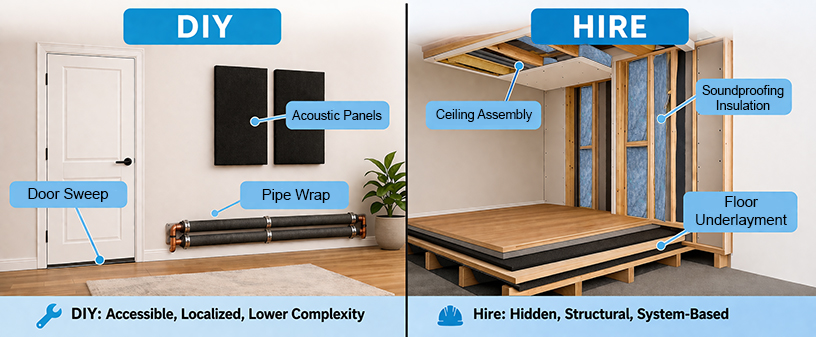
These projects are often realistic DIY starting points because the treatment area is accessible and the fix is targeted. You are not trying to redesign the whole structure. You are addressing a specific weakness you can actually get to.
Pipe wrap
Pipe wrap is often a good DIY option when the noisy section of a pipe is exposed and the sound is clearly coming from the pipe itself. This often shows up as rushing water noise, drain pipe noise, flushing sounds, or wastewater movement from accessible plumbing in basements, utility rooms, crawl spaces, or open framing during a renovation.
In those situations, Quiet Wrap™ Pipe Soundproofing Wrap can be a practical starting point because it goes directly on the pipe and helps reduce noise at the source. The key is making sure the pipe itself is really the problem. If the pipe is buried in finished construction, or if vibration is being carried into the surrounding framing or hangers, the job may be more involved than a simple wrap-and-done fix.
Door products
Door products are another strong DIY category because sound often leaks around the door opening, not just through the wall itself. Small gaps at the sides, top, and bottom of the opening can let a surprising amount of sound through, which is why the door is often the first place to check.
Products like Quiet Door™ Perimeter Seal, Quiet Door™ Adjustable Perimeter Seal, and Quiet Door™ Sweep are designed to address those leakage points. They can make a real difference when the issue is air gaps around the opening. What they will not do is change the basic limitation of a light hollow-core door, so they work best when the weak point is the opening itself rather than the door slab alone.
Acoustic panels
Acoustic panels are a good DIY choice when the problem is echo, reverberation, or poor sound quality inside the room. This is common in home offices, studios, restaurants, gyms, home theaters, and other spaces with a lot of hard surfaces that reflect sound back into the room.
This is where Udderly Quiet® Acoustic Panel 200 Series fits. These panels help reduce reflected sound and improve clarity inside the space, which can make conversations easier to hear and the room less harsh overall. They are not meant to block sound coming through a shared wall, floor, or ceiling, so they are the right choice when the issue is room acoustics, not sound transfer between spaces.
Projects That Are Usually Better Left to a Pro
These projects are usually better left to a pro because the result depends on hidden construction, multiple materials working together, or the way a full wall, floor, or ceiling assembly is built. Once the project moves into that category, installation quality becomes a major part of whether the solution works.
Floor soundproofing
Soundproofing a floor usually moves out of DIY territory once the job requires pulling up finished flooring or rebuilding part of the floor system. This is especially true when the complaint is impact noise, such as footsteps from above, dropped objects, chair movement, or heavy thuds traveling between levels.
Those problems are difficult because the noise is often being carried as vibration through the structure itself, not just through the air. That means surface-level fixes usually do not go far enough. These jobs can also affect floor height, door clearance, trim, and transitions into adjacent rooms, which is why they are often better handled by someone with flooring and assembly experience.
Wall soundproofing
If the noise is traveling through the wall itself, the solution usually depends on more than one part of the wall build working together. Some materials help absorb sound inside the wall cavity, while others add dense mass and separation to help reduce how much sound passes through the wall. The result also depends on sealing gaps, handling penetrations carefully, and making sure the wall is built correctly so sound does not bypass the system.
Quiet Batt® Soundproofing Insulation and Quiet Barrier® HD Soundproofing Composite can both play a role here, but they do different jobs. Quiet Batt® helps absorb sound energy inside the wall cavity, while Quiet Barrier® HD Composite adds dense mass and a layer of separation as part of the wall assembly. Once the project depends on what is happening inside the wall, good installation matters just as much as the materials themselves.
Larger wall, ceiling, or floor assemblies
Larger assemblies are more complex because the sound path is often not limited to one obvious surface. A wall may be part of the problem, but sound can also move through the ceiling line, floor structure, adjoining framing, or other flanking paths that let noise bypass the area you treated.
That is why these projects usually involve more than one product and more than one surface. Materials like Quiet Batt® and Quiet Barrier® HD Composite may be part of the solution, but they only work as intended when the larger system is designed and installed correctly. Once the project depends on the whole assembly, it is usually much more likely to succeed when handled by someone with real construction and sound-control experience.
When to DIY a Soundproofing Installation
DIY is usually the right route when the source or weak point is clear, the treatment area is accessible, and the fix is limited in scope.
That is often true with exposed pipe noise, leakage around a door, or reflected sound inside a room.
When to Hire a Professional for Soundproofing
Hiring usually makes more sense when the issue involves a wall, floor, or ceiling assembly, the treatment area is hidden behind finished construction, several materials need to work together, or the expected result is substantial sound reduction between spaces.
The best route depends on what kind of noise problem you actually have, how accessible the weak point is, and how much of the result depends on the assembly around it.
Before you buy anything, answer the real question first: Can you clearly identify the source or weak point, reach it, and treat it directly?
If the answer is yes, DIY may be the right place to start. If not, and the problem depends on hidden construction or a full wall, floor, or ceiling system, bringing in a pro is usually the smarter move. Making that decision early can save you time, money, and frustration.
Not sure where to start?
Give Soundproof Cow a call at 1-866-405-7794 or submit a contact form. We can help you think through the problem, identify the right product category, and determine whether your project is something you can handle yourself or one that may need a more advanced approach.

About Ryan Ingram