
0 ItemsView Cart

Updated on May 03, 2026
When customers ask us which building materials actually help reduce noise, we start with one simple point: different materials solve different noise problems.
Here is the short version. Insulation helps inside wall and ceiling assemblies. Drywall and sheetrock help by adding mass. Ceiling tiles can help reduce noise in some commercial and drop-ceiling settings. Acoustic panels help reduce echo inside a room. No single material is best for every noise problem because each one solves a different part of the problem.
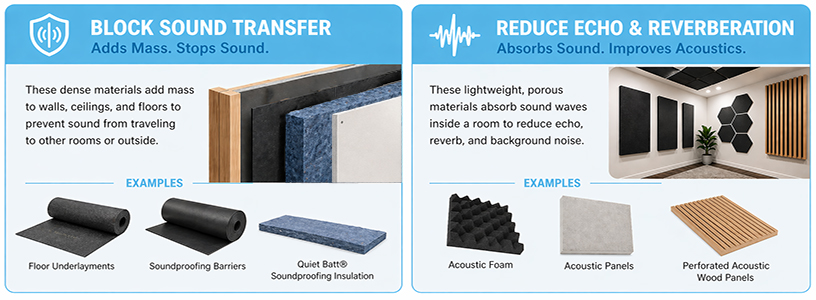
If we are trying to keep sound from moving between rooms, we think first about sound blockers and assemblies. If we are trying to make a room less harsh, less echoey, and easier to use, we think first about absorption. That is the fork in the road. Get that right, and material selection gets much easier. Get it wrong, and the project usually gets more expensive than it needs to be.
Which Building Materials Help Block Sound?
-
Insulation
Insulation helps reduce sound transfer through wall and ceiling assemblies. It is used in cavities to increase density. Quiet Batt® is our 3-inch soundproofing and thermal insulation product for walls or ceilings. It is designed to friction fit for easy installation. It can be used on its own or with other soundproofing materials, depending on the project.
This is where people sometimes get confused. Insulation can absolutely help with sound control, especially inside a wall or ceiling cavity, but cavity absorption alone does not solve every sound-transfer problem. If the complaint involves framing, gaps, penetrations, or a larger assembly issue, insulation is usually part of a solution, not the entire solution alone.
-
Drywall
Drywall helps reduce noise by adding mass to a wall or ceiling. That matters because heavier, denser assemblies are harder for airborne sound to move through. But drywall works best when it is part of a layered system. We would never look at one extra layer of drywall and call it a complete soundproofing plan for a difficult wall or ceiling problem.
This is one of the most common misunderstandings we see. People know drywall is part of a wall, so they assume “more drywall” automatically means “soundproof.” In reality, drywall is often one piece of a larger assembly. The moment sound is moving through framing, openings, or connected surfaces, drywall alone is rarely enough.
-
Sheetrock
For most customers, sheetrock belongs in the same conversation as drywall. If you are using “sheetrock” to mean a gypsum wall panel, the same rule applies: it can help with sound control by adding mass, but its performance still depends on the full wall or ceiling system around it.
So if you ask us whether sheetrock helps reduce noise, the honest answer is yes, it can. But do not expect sheetrock by itself to solve a serious sound-transfer problem.
Which Building Materials Help Reduce Echo?
-
Acoustic Panels
Acoustic panels help reduce echo and improve sound quality inside a room. We use them when the real problem is reverberation, poor speech clarity, or a room that sounds harsh even though the noise is being created inside that same space. That is where our Udderly Quiet® Acoustic Panels fit. The 200 Series is our general all-around acoustic panel and one of our most popular options for spaces where noise and reverberation are the real issue.
What acoustic panels do not do is block sound transfer between rooms. We use them to improve the acoustics inside a room, not to stop sound from passing through a wall, floor, or ceiling.
-
Ceiling Tiles
Ceiling tiles can help reduce noise in some settings, especially where room acoustics are the main concern or where a suspended ceiling system is already part of the space. In commercial interiors and drop-ceiling environments, some ceiling systems can contribute both absorption and sound blocking, depending on the tile and the full system performance.
But ceiling tiles are not the same thing as a fully soundproof ceiling. Even high-performing suspended ceiling systems are still not the same as a sealed, rebuilt structural ceiling. That is why we would describe ceiling tiles as helpful in the right environment, not as a cure-all for every ceiling noise problem.
Which Building Materials Are Commonly Misunderstood?
-
Acoustic Panels Will Not Soundproof a Room
This is probably the biggest misunderstanding in the whole category. Acoustic panels improve room acoustics. They absorb reverberation inside the room. They do not stop sound transfer through a shared wall, floor, or ceiling. If the noise you are trying to control is entering from somewhere else, panels are usually the wrong starting point.
We use panels when a customer tells us a room sounds echoey, harsh, muddy, or hard to talk in. We do not use them when the real complaint is “I can hear through the wall.”
-
Ceiling Tiles Do Not Make a Ceiling Completely Soundproof
Ceiling tiles can absolutely help, but we would never tell a customer they make a ceiling completely soundproof. Some ceiling systems are very good at improving sound absorption. Some also help block airborne sound between adjacent closed spaces. But that is still not the same thing as saying any drop ceiling becomes a fully soundproof ceiling.
This is where ratings matter and oversimplification gets people in trouble. Even the highest CAC-rated ceiling tiles can have performance issues because the ceiling grid needed to support the tiles does not allow for an airtight assembly.
-
Drywall Alone Is Not a Complete Soundproofing System
Drywall helps. Sheetrock helps. Added mass matters. But more demanding noise problems usually require multiple materials working together. If sound is moving through the full wall or ceiling assembly, drywall alone is rarely the whole answer.
That is why we keep coming back to the assembly. We want to know what the wall is made of, what is inside it, what is around it, and where the sound is actually traveling. If we skip that and just say, “add drywall,” we are guessing, not solving.
Which Material Is Best for Your Noise Problem?
For Shared Walls and Ceilings
- If the issue is sound transfer through a shared wall or ceiling, insulation, drywall, and assembly-based solutions are usually the better fit. That is where Quiet Batt® can help as part of a wall or ceiling assembly. If the cavity is open and we need absorption inside that assembly, batt insulation may belong in the plan. If we need more surface sound blocking and the surface is actually part of the problem, a barrier layer may also belong in the conversation.
- What we would not do is point you to one material without understanding the whole setup. Shared walls and ceilings are where details matter most. This is usually where customers either save money by diagnosing the problem correctly or waste money by trying to shortcut the assembly.
For Echo and Reverberation
- If the issue is echo and reverberation, acoustic panels and other absorptive materials are usually the better fit. That is where Udderly Quiet® Acoustic Panels make sense. We use them to improve clarity, reduce harsh reflections, and make a room more comfortable to talk in, work in, or listen in.
- This is also where customers can often get the most noticeable improvement without turning the project into a major build. If the room sounds bad because of reflections inside the room, absorption is usually the smarter path than trying to “soundproof” the entire space.
For Mixed or Unclear Problems
- If the problem is mixed or unclear, we start by figuring out whether the issue is sound transfer, room acoustics, or both. This will determine what materials are needed.
- This is exactly why we offer a free acoustic analysis. If you are not sure what you are hearing or where it is coming from, we would rather help you sort that out first than have you spend money on the wrong material. Our form asks about the type of space, whether construction is allowed, room dimensions, and what the walls, ceilings, or floors are made of so we can steer you toward a more accurate solution.
Not Sure Which Material You Need?
If you are not sure where to start, we can help you choose the right solution based on your noise issue and your space type.
FAQ
What building material is best for reducing noise?
The best material depends on the type of noise problem. Dense, layered assemblies are usually better for blocking sound transfer, while absorptive materials are better for reducing echo inside a room.
Does insulation help with soundproofing?
Yes. Insulation can help reduce sound transfer inside wall and ceiling cavities, especially when it is part of a larger assembly. Quiet Batt® is designed for that kind of use in walls, ceilings, and attic applications.
What is the best insulation for soundproofing a ceiling?
Ceiling insulation can help with airborne sound, but ceiling noise is often more complicated because sound may also travel through penetrations, framing, and adjacent surfaces. That is why we usually look at the whole assembly, not insulation alone.
Is drywall good for soundproofing?
Drywall can help by adding mass, but it is usually more effective as part of a larger system. If the problem is more demanding, drywall alone is rarely the whole answer.
Is sheetrock good for soundproofing?
Sheetrock can contribute to sound control, but it is rarely a complete solution on its own. The same core rule applies as with drywall: performance depends on the full assembly.
Do ceiling tiles reduce noise?
Yes, they can. Ceiling tiles can help absorb sound inside a space, and some ceiling systems can also help reduce airborne sound between adjacent closed spaces. But even strong-performing ceiling tiles have limits, because a suspended ceiling system is not a sealed assembly. That is why ceiling tiles can help with noise control, but they are not the same thing as a truly soundproof ceiling.
Are acoustic panels soundproofing materials?
No. Acoustic panels are sound absorption materials. They help reduce echo and improve clarity inside a room, but they do not block sound transfer the way true soundproofing materials do.

About Ryan Ingram